

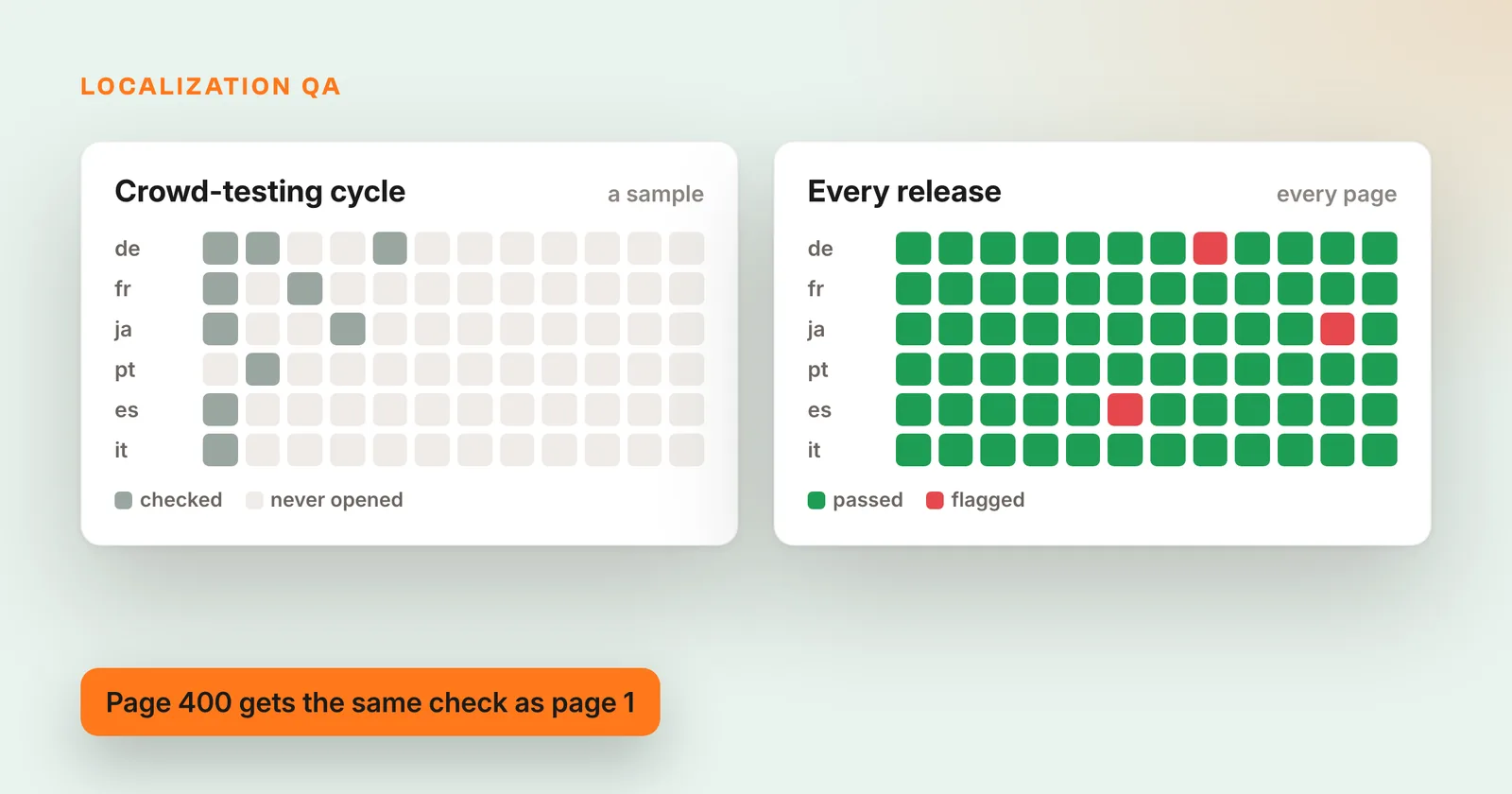
Ship a product in fifteen languages and you have not built one product. You have built fifteen products, each with its own date formats, plural rules, string lengths, and layout edge cases. Most teams test one of them: the one they speak.
Everyone else ships on faith. The German build looks fine in a five-minute skim. The Japanese build compiles, so it must be fine too. Page 400 of the Portuguese site, the one nobody has opened since launch, gets tested by nobody until a customer finds it.
Why a testing cycle takes five weeks
Crowd-testing is the usual fix, and it runs slow for reasons that are structural, not incidental.
Each cycle starts by staffing a tester panel: a fresh set of testers per locale, recruited and briefed for that job. Coverage then depends on who picks up the work. Testers self-select tasks from a queue, so a careful native speaker and someone racing through for the payout end up filing very different reports, and you cannot tell which one you got until the results come back.
The panel also samples rather than covers. Nobody has five weeks and a per-task rate to click through every page in every locale, so the plan is to check a representative slice and call it done. And nothing carries over between cycles: the next release starts a new job with a new panel, so last cycle's findings do not become this cycle's regression suite. You pay for the same discovery work again, every time.
Five weeks is not a scheduling inconvenience. It is the sum of those four mechanisms.
What a four-hour run looks like instead
Donobu runs the same check in about four hours. The difference is not speed. It is a different mechanism underneath.
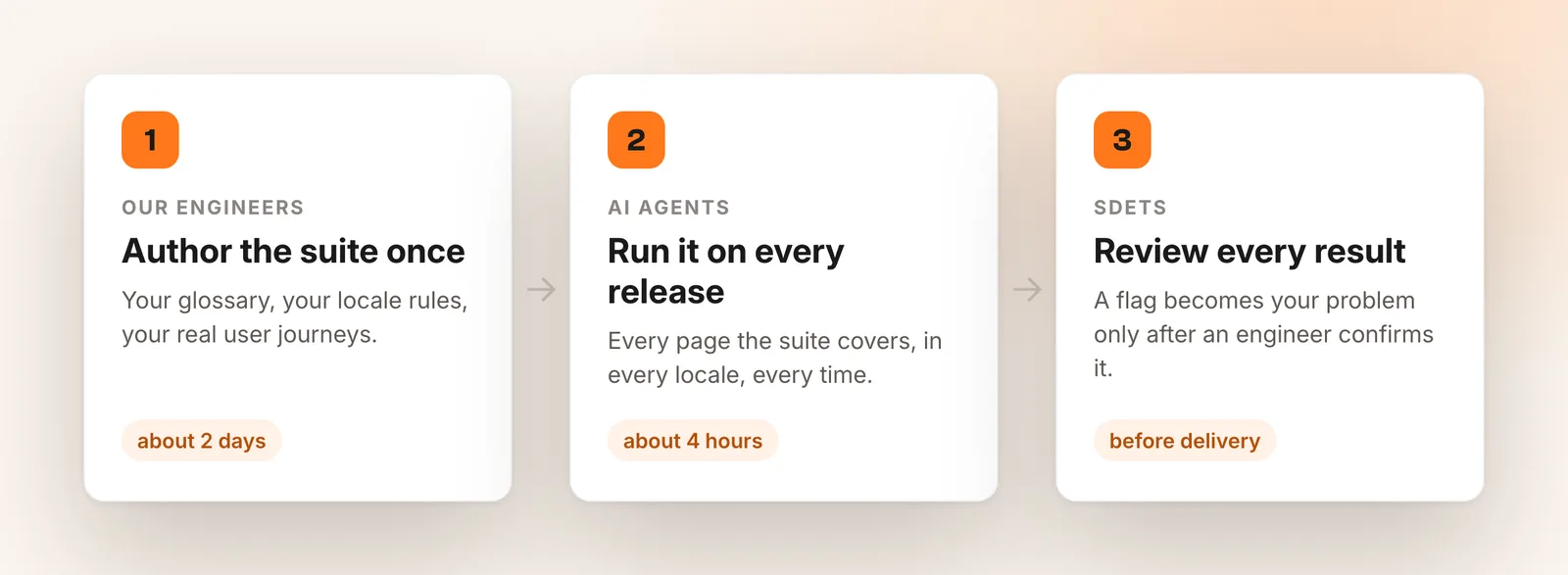
Forward-deployed engineers in test (FDETs), engineers who work directly with your team, author the suite once, against your actual glossary, your locale rules, and your real user journeys. That suite is a durable asset: it encodes what "correct" means for your product in each language, so nobody starts from a blank page next release.
AI agents run that suite on every release, not a sample of releases. There is no queue for someone to pick up, so there is no variance in who showed up for the job this week. The agents run the same suite against the current build, every time you ship.
Software development engineers in test (SDETs) review every result before it reaches you. The agents flag what looks wrong; an engineer confirms the flag is real before it becomes your problem. That review step keeps the whole thing honest: the AI does the repetitive checking, engineers still make the judgment call.
note
Coverage used to be a matter of tester enthusiasm: how much of the product a panel got through before the clock ran out. It is not anymore. Page 400 gets the same rigor as page 1, because once the suite covers a page, it covers that page every run, in every locale it is pointed at.
| Crowd-testing cycle | Four-hour run |
|---|---|
| New tester panel staffed per cycle | Suite authored once by FDETs |
| Coverage depends on who picks up the job | Same suite runs on every release |
| Samples a slice of pages per locale | Every page the suite covers, every run |
| Findings do not carry to the next cycle | Every result reviewed by an SDET before delivery |
Pricing follows the outcome
Crowd-testing bills for tester-hours: more testers, more hours, more invoice, with only a loose connection to how thorough the check actually was. Donobu prices per page per locale checked. You are paying for the unit that matters (a checked page in a checked locale), not for time logged by someone you never see working.
Run the same footprint both ways and the four-hour model typically costs about half of what a crowd-testing cycle costs. That gap comes from removing the staffing and idle time a five-week panel needs, and replacing it with a suite that already exists.
Own your tests
None of this asks you to hand your test coverage to a platform you cannot inspect. Runs execute local-first or inside your own environment, so the check happens where your code already lives.
What you get back is native Playwright. Not a proprietary format, not a runner that only works inside Donobu's platform. You own the suite the way you own any other test file in your repository: read it, change it, run it yourself if you want to, with or without us. A test suite you cannot take with you is not really yours.
Quality as a system, not a phase
A five-week cycle treats quality as something you schedule between releases. That works fine when releases are rare. It stops working the moment your release cadence outruns your test cycle, and for most teams shipping today, it already has.
Continuous Quality is the alternative: testing runs at whatever pace you ship, not on a calendar written months in advance. A four-hour localization check is one piece of what that looks like in practice, not a faster version of the old cycle, but a different system running underneath it.
If you ship in more than one language and have not checked what actually gets tested in each one, book a demo and bring your least-tested locale.